Boston Police Overtime Data Analysis 📊
Overview
This project analyzes the Boston Police Department's budget and overtime usage over the past decade to identify inefficiencies and trends. By conducting this analysis, we sought to determine if police spending aligns with community safety needs. We Worked with American Civil Liberties Union (ACLU) to conduct this research which they used and presented in their lawsuit.
Key Findings
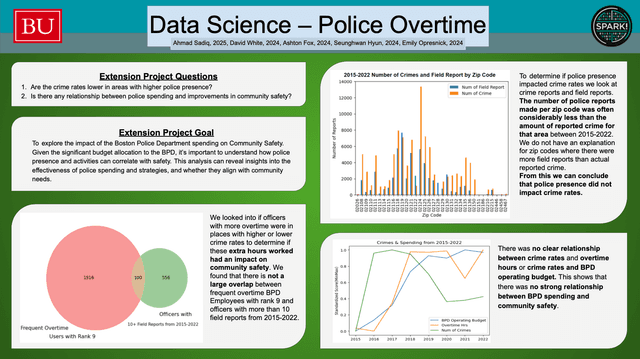
- The number of field reports often exceeded actual reported crimes, indicating that police presence did not impact crime rates.
- There was no significant correlation between crime rates and police overtime hours or the BPD's operating budget.
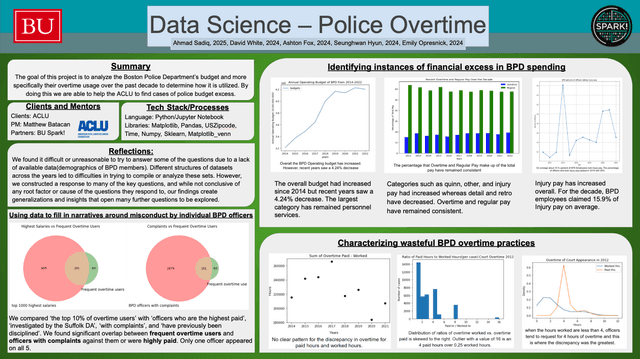
- BPD funding has increased consistently since 2014, primarily allocated to personnel services, including overtime pay.
- Officers with frequent overtime usage were often among the highest-paid and those with internal complaints or misconduct records.
- Discrepancies were found in overtime hours worked versus paid, with instances where officers were compensated for significantly more hours than recorded work.
In Depth
The project utilized multiple datasets, including earnings, crime incidents, field activity, and budget records from the City of Boston. Using Python utilizing libraries including Pandas, Matplotlib, and Sklearn, we processed and analyzed these datasets to uncover spending inefficiencies. Regression models indicated that crime rates were not a predictor of overtime hours or police budget allocations. Further analysis of specific officers revealed that some of the most frequent overtime users were also officers with past complaints and high salaries.
The project utilized multiple datasets, including earnings, crime incidents, field activity, and budget records from the City of Boston. Using Python utilizing libraries including Pandas, Matplotlib, and Sklearn, we processed and analyzed these datasets to uncover spending inefficiencies.